Drag to rotate · Wheel / two fingers to zoom & pan
This device cannot show the 3D view. Follow the step pictures and text below instead.

1. Fold in half and unfold
Lay the paper sideways, coloured side up. Fold the bottom edge to the top edge and unfold to make a middle line.
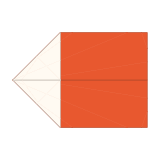
2. Fold the left corners to the middle
Fold the two left corners in so the left edge lies on the middle line.
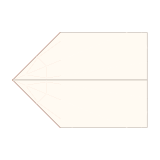
3. Turn over
Turn the paper over top to bottom. The point stays on the left.
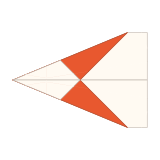
4. Fold the slanted edges to the middle
From the left point, fold the upper and lower slanted edges to the middle line. The hidden triangles underneath fold along with them.
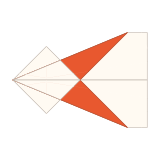
5. Pull the corners out from behind
Pull the tips of the hidden triangles out from behind, one up and one down, and flatten them. The front becomes a white diamond.
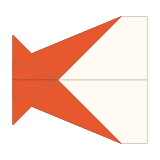
6. Fold the nose back
Fold the left point of the diamond over to the right so it meets the point where the coloured triangles meet. The crease joins the diamond’s top and bottom corners.
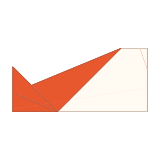
7. Fold in half
Fold the lower half behind along the middle line.
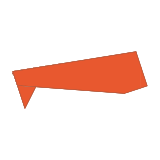
8. Fold the wings down
Fold the front wing down along a line that starts at the bottom of the nose and rises to about 4 cm above the bottom edge at the tail. Fold the back wing behind along the same line.
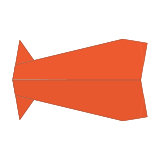
9. Open the wings
Open both wings almost square to the body, with a very shallow upward V. Small triangles stick out at the front like a squid’s fins.
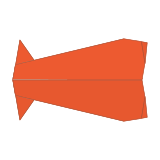
10. Bend up the elevators
Bend the outer back edge of each wing up just a little. Make both sides the same and it is ready to fly!
1. Fold in half and unfold
Lay the paper sideways, coloured side up. Fold the bottom edge to the top edge and unfold to make a middle line.
Tip:
Finished!
Well done! Watch it again or try another model.
The science of a long flight
- Centre of gravity: the layered nose is heavy, so the centre of gravity sits toward the front of the wings. If the nose lifts, the plane settles back into a steady glide.
- Elevators: bending the back edge of the wings up a tiny bit lifts the nose for a long glide. If it dives, bend them up a little more; if it climbs and stalls, bend them down a little.
- Symmetry: if it turns right, raise the back edge of the left wing a little more (and the opposite if it turns left).
- Throwing: hold the body, keep the wings level and push it forward gently. There is no need to throw hard or upward.
- Safety: never throw it toward people’s or animals’ faces.
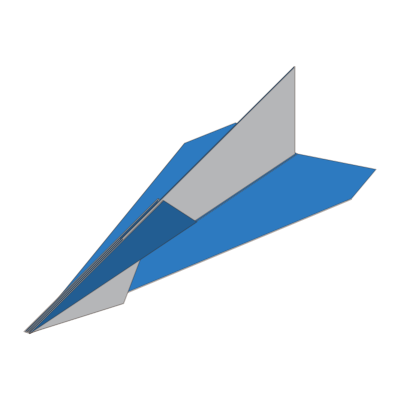 Paper airplane (dart)
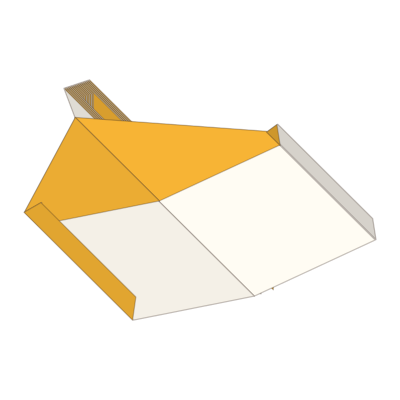 Long-flying glider
 Miura fold